When Sony releases a new pair of WH 1000X headphones, the tech world pays attention. Not because the company radically reinvents its formula every time, but because it rarely gets things wrong. The WH 1000XM5 became one of the most recommended noise canceling headphones of the past few years. They were comfortable, refined, and remarkably good at silencing the world.
Now the WH 1000XM6 has arrived with a higher price and a promise of meaningful upgrades. The big question is simple: is this just another incremental refresh, or is this the moment where upgrading actually makes sense?
To answer that properly, we need to go point by point. Sound. Noise canceling. Comfort. Battery. Features. Connectivity. Microphones. Build. And finally, value.
Let’s break it down.
At first glance, the XM6 looks extremely similar to the XM5. Sony is clearly confident in the clean, minimalist aesthetic it introduced with the previous generation. The floating headband, smooth matte finish, and seamless earcups all return.
Image Credits: Sony Electronics
But this is not a copy paste job.
The most noticeable structural change is the return of foldable hinges. The XM5 did not fold inward, which made its carrying case larger than many users liked. With the XM6, Sony brings back inward folding earcups, making the headphones more compact when packed. For frequent travelers, this alone is a practical improvement.
Image Credits: TechRadar
The headband has also been refined. The XM6 features a wider, flatter design with an asymmetrical cross section. This spreads pressure more evenly across the top of your head. The clamping force feels slightly more balanced. It is not dramatically lighter, but the pressure distribution reduces fatigue during long sessions.
The earcups remain soft and plush, but the padding is slightly tweaked. The seal feels gentler, and for most users that translates into better long term comfort.
Image Credits: Amazon
These changes are subtle. But they are deliberate.
The XM5 already delivered a warm, bass forward sound signature. It leaned into a V shaped tuning with a strong low end and slightly lifted highs. It was exciting, energetic, and fun, especially for pop, hip hop, and electronic music.
The XM6 builds on that character but tightens it.
Sony introduced updated driver technology with perforated voice coils designed to improve high frequency extension and clarity. In practical listening, the difference is noticeable. The bass is still present and powerful, but it feels more controlled. It punches without spilling into the mids.
Vocals sound clearer. There is better separation between instruments. Acoustic tracks reveal more texture in strings and percussion. The treble feels smoother and less artificially boosted compared to the XM5.
The XM6 also reduces the bass emphasis slightly. The XM5 had a stronger bass bump, which some listeners loved and others found excessive. The XM6 feels more balanced overall. It is still warm, but it is less exaggerated.
For listeners who prefer neutrality, the XM6 is easier to equalize. Both models support a 10 band EQ and Sony’s audio processing features, but the XM6 requires fewer corrections to sound natural.
Image Credits: What Hi-Fi?
In short, the XM6 sounds more mature. It is not a radical transformation, but it is clearly more refined.
If there is one area where the XM6 clearly distances itself, it is noise canceling.
The XM5 already offered excellent active noise canceling. It was particularly strong at mid and high frequency sounds like chatter, keyboard clicks, and office noise. However, it was slightly less aggressive in handling low frequency rumble compared to some competitors.
The XM6 introduces a new QN3 noise canceling processor that is significantly faster than the previous generation’s chip. It also increases the total microphone count to twelve, with six dedicated to voice pickup and the rest focused on environmental noise detection.
Image Credits: Ubuy Spain
The result is stronger and more consistent cancellation across a broader frequency range.
Human voices are quieter. Airplane engine hum feels more suppressed. Traffic noise fades more convincingly into the background. The overall sensation is less about simply reducing noise and more about creating a controlled acoustic bubble around you.
The difference is not subtle in challenging environments. In a busy café or airport, the XM6 feels more composed and more confident in silencing distractions.
For frequent travelers or commuters, this alone may justify the upgrade.
Both the XM5 and XM6 are lightweight headphones, sitting around the same overall weight. But comfort is about more than grams.
The XM6’s redesigned headband distributes pressure more evenly. That wider, flatter surface reduces the concentrated hotspot some users felt with the XM5 during extended wear.
The earcups remain soft and breathable. However, the lighter clamp on the XM6 can be a double edged sword. For most people, it enhances comfort. But for glasses wearers, the softer seal may allow small gaps that affect bass response and noise canceling consistency.
Image Credits: Kevin The Tech Ninja
The XM5 had a slightly firmer seal, which some glasses wearers preferred. This is a detail worth considering if you wear frames daily.
Overall, for the majority of users, the XM6 feels extremely comfortable for long listening sessions. It is subtle, but fatigue sets in more slowly.
Battery life remains consistent between the two generations.
Both offer around 30 hours of playback with active noise canceling enabled and up to 40 hours with it turned off. In real world usage, you can expect roughly a full day or more of heavy listening before reaching for a charger.
Fast charging remains a strong point. Just three minutes of charging can deliver around three hours of playback.
The XM6 adds one small but meaningful convenience: the ability to listen while charging using the analog cable. The XM5 did not support this. If you are caught with a drained battery, this gives you more flexibility.
It is not a dramatic improvement, but it is practical.
Both headphones rely primarily on high quality plastics with metal reinforced structural elements. Neither model is officially water resistant, and both feel solid without being heavy.
The XM6 introduces more durable folding hinges compared to the fixed structure of the XM5. This improves portability and may improve long term durability in daily use.
The carrying case has also been redesigned. It is smaller thanks to the folding mechanism and uses a magnetic clasp instead of a zipper. This allows easier one handed access.
Image Credits: Mashable
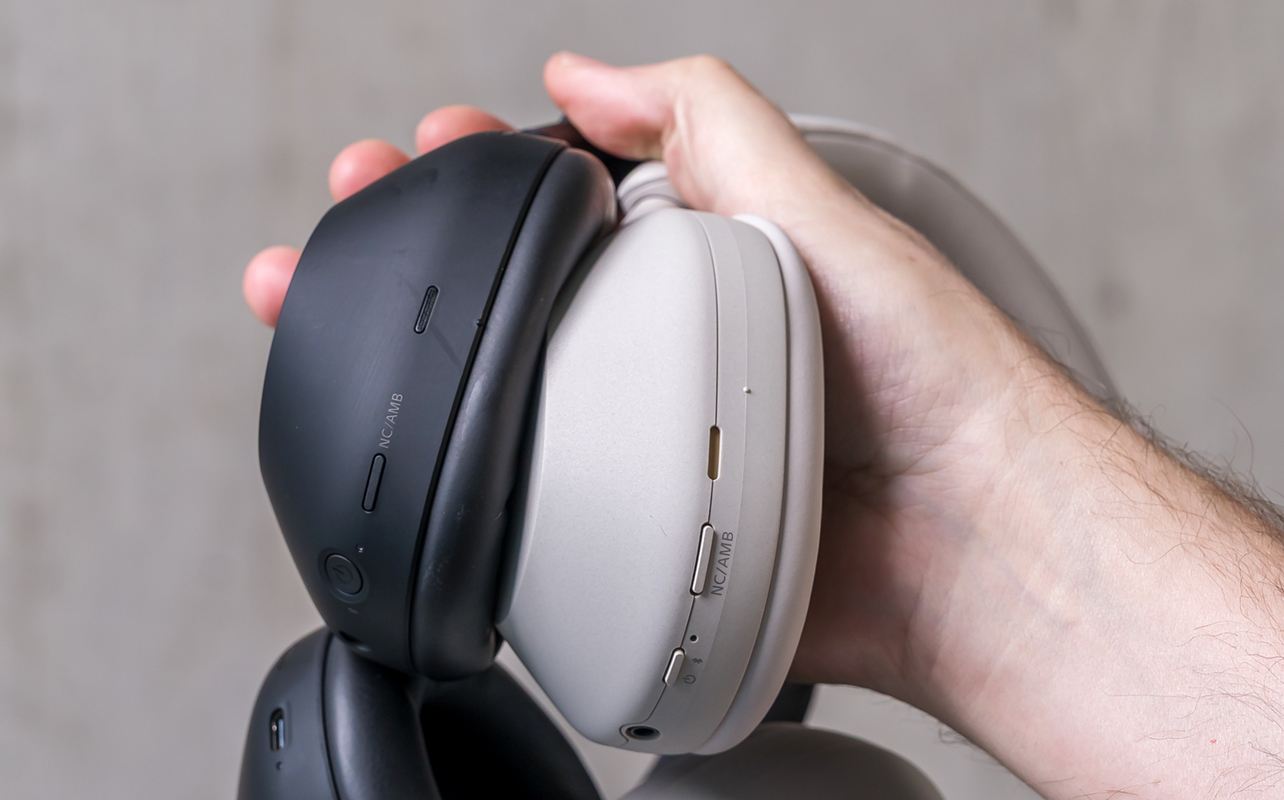
Control layout is slightly improved as well. The XM6’s power button is now more distinct in shape and feel, reducing confusion with the noise canceling button. There is also a new double press function to mute the microphone during calls.
Image Credits: BestBuy Blog
These changes are small but thoughtful.
Sony continues to pack its flagship headphones with smart features.
Both models support Adaptive Sound Control, which automatically adjusts noise canceling based on your location and activity. Both include Speak to Chat, which pauses playback when you start talking, though it can occasionally trigger unintentionally.
The XM6 introduces a new spatial sound upmixing mode designed to create a more cinematic experience from stereo content. It also supports Bluetooth LE Audio and Auracast functionality, which prepares it for future broadcast audio scenarios.
Multipoint pairing remains available on both models, allowing you to connect to two devices simultaneously. Switching between phone and laptop is seamless.
Touch controls remain intuitive, allowing swipe gestures for volume and track changes.
The XM6 does not revolutionize the feature set, but it expands it.
The XM5 uses Bluetooth 5.2. The XM6 upgrades to Bluetooth 5.3 with support for LE Audio and the LC3 codec.
Both headphones support SBC, AAC, and LDAC for high resolution wireless audio. Neither supports aptX.
The addition of LC3 prepares the XM6 for lower latency and more efficient streaming in compatible ecosystems. While not every device supports this yet, it makes the XM6 more future proof.
Both models include a 3.5 mm analog input for wired listening. Neither supports digital audio over USB C.
Connectivity on both is excellent, but the XM6 clearly pushes further toward next generation standards.
Call quality is another area where the XM6 improves.
Mashable: https://mashable.com/comparison/sony-wh1000xm6-vs-sony-wh1000xm5
The XM5 delivered clear voice pickup but sometimes sounded slightly thin. Background noise suppression was solid but not exceptional in very loud environments.
The XM6 increases the number of dedicated voice microphones and introduces a more advanced AI processing model trained on a massive dataset of voice samples.
In practice, voices sound fuller and more natural. Background noise is suppressed more effectively. Wind resistance is improved, though not perfect.
For professionals who frequently take calls on their headphones, this is a noticeable upgrade.
At launch, the XM6 carries a higher price than the XM5 did at its debut. Meanwhile, the XM5 is now widely discounted.
This creates a real dilemma.
The XM6 is objectively better in almost every category. Sound is more balanced. Noise canceling is stronger. Comfort is refined. Connectivity is more advanced. Microphone quality is improved. Portability is better thanks to folding hinges.
But the improvements are incremental rather than revolutionary.
If you already own the XM5 and are satisfied, the upgrade is not urgent. The XM5 remains an excellent headphone.
However, if you are coming from an older model such as the XM3 or XM4, or from a competitor, the XM6 represents the most polished version of Sony’s formula to date.
Yes, but with context.
The XM6 is not a dramatic redesign. It is a comprehensive refinement. Sony identified small weaknesses in the XM5 and addressed them methodically. Stronger noise canceling. Better sound balance. Improved portability. Enhanced call clarity. Smarter connectivity.
Each improvement alone may seem modest. Together, they create the most complete version of the WH 1000X series yet.
For new buyers seeking the best noise canceling headphones Sony has ever made, the XM6 makes perfect sense.
For XM5 owners, it is a thoughtful upgrade that rewards attention to nuance rather than spectacle.
And in the premium headphone world, sometimes refinement is exactly what progress looks like.